The New Creative Renaissance: AI as the Catalyst, Not the Creator

.avif)
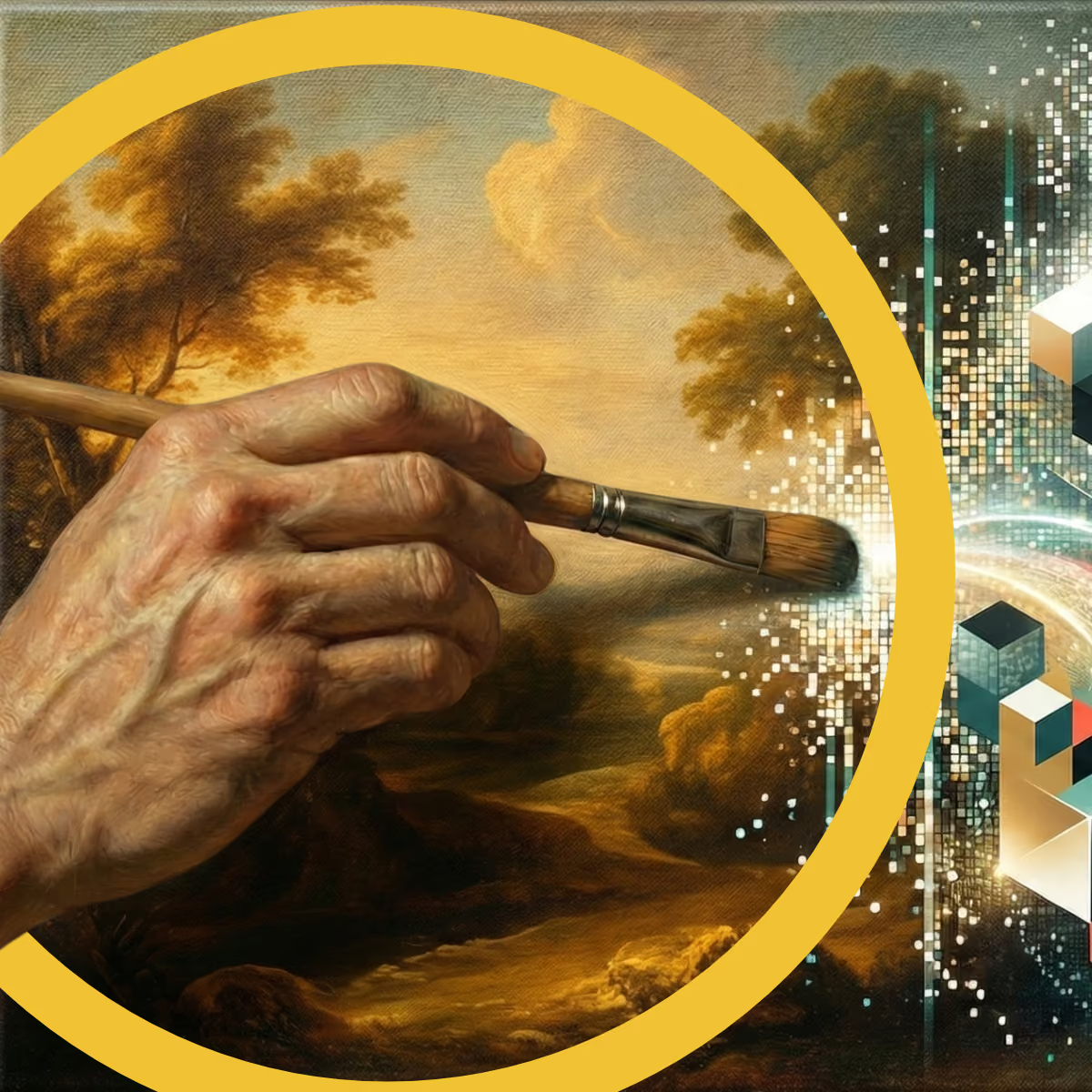
Though many fear that generative AI will suppress creativity, we see the opposite occuring. Technology is now at a place where it's accelerating possibility, making imagination the most valuable currency in a new renaissance. In our recent Lunch & Learn with Shutterstock, their Director of Creative Strategy, Cal Roberts, captured this moment perfectly: Generative AI isn’t replacing creativity; it’s redefining it.
To stay at the forefront of this new renaissance, it will be important to understand where AI can help you — by accelerating outputs, as in Shutterstock's examples. But we'll also need to understand when it's most impactful to return to physical, human-made creation. The brands who can effectively find that balance will be the ones who win.
Speed Meets Originality — And the Creative Still Reigns Supreme
AI can execute, but it cannot imagine. It doesn't understand brand nuance, emotional tone, or the story behind the campaign. That remains the domain of the creative mind.
As Cal shared during the session, "The tool doesn't replace creative thinking; it removes barriers that slow it down." And those barriers are falling fast. Today’s generative AI enables teams to generate original, commercially licensed imagery in minutes — visuals that once required weeks of production can come to life almost instantly.
But speed isn't the real story here. It's the originality that speed enables. Shutterstock’s technology, for example, is built from 15 unique AI models trained across diverse aesthetics, allowing brands to create imagery as distinctive as their story — breaking free from the sea of sameness that defines so much of today's visual landscape. No more generic handshakes and city skylines.
Like any new tool, those who go through the motions will get something uninspired, but in the right creative human hands, this has the power to truly amplify creativity. When production guardrails disappear, ideas become bigger, bolder, and more ambitious because they can be realized without friction. AI becomes what it was always meant to be: a tool for human expression, not imitation.
Of course, that requires responsibility. Platforms like Shutterstock have taken thoughtful steps to ensure ethical use with human review and clear licensing. As creators and marketers, it's up to us to use these tools with that same integrity — to enhance creativity, not replace it.
The Return of Craft
Ironically, as AI-generated work floods the creative landscape, it’s the imperfect, physical, human-made things that will feel most alive.
In a world where pixels are endless and outputs are instant, we’ll crave the weight of the brush, the press of the finger, the trace of the maker’s hand. This is the creative counterbalance to AI: the resurgence of tactile, experiential craft. The brushstroke in a painting, the grain of a carved surface, the uneven edge of a letterform drawn by hand, they all become more than artistic details; they’re proof of presence. They remind us that art is not just seen, but felt, because they exist in the shared moment between creator and audience.
As generative tools handle scale and speed, human craft becomes the mark of authenticity and the story behind the surface. The next era of creativity is about reintroducing touch where the artist's hand becomes the new luxury, the signature of originality in an increasingly automated world.
Brands Need to Integrate
Here's the surprising truth: when you effectively integrate human creativity with efficient AI production, these skills feed off each other — enhancing both simultaneously, because understanding craft makes you a better prompter. The same instincts that guide a designer's hand, the knowledge of composition, color theory, texture, and form, translate directly into more innovative, precise AI direction. Creatives who understand why a visual works articulate what they want with nuance. Cultivating that craft knowledge could be the key that unlocks the full potential of AI.
For marketers and creative teams, the mastery of craft plus the mastery of AI:
- Accelerates ideation by visualizing and testing campaign concepts in hours, not weeks.
- Reduces production bottlenecks by generating original imagery to support fast-moving initiatives.
- Expands creative diversity by reflecting global perspectives and inclusive representation often missing from stock libraries.
- Enhances brand storytelling by tailoring outputs that stay true to your brand’s aesthetic and voice.
Ultimately, AI frees creative teams to spend less time on execution and more time on what matters most: the big ideas that move people. The technology might make creativity faster, but it’s still human insight, judgment, emotion, and craft mastery that make it meaningful.
Start Your Own Creative Renaissance
Like every great movement in art and design, it rewards those willing to experiment.
To begin exploring how AI can amplify your creativity:
- Experiment boldly. Use AI tools to explore new visual styles, perspectives, and ideas that push your brand’s aesthetic.
- Collaborate across disciplines. Bring AI into your brainstorming and concepting phases to accelerate innovation.
- Define your standards. Understand the licensing, usage rights, and ethical boundaries before you publish.
- Stay curious. Technology will keep evolving, and so should your creativity.
AI is not the artist. You are. But now, you have a studio that’s infinite, immediate, and filled with possibility.
Download our AI in Marketing Guide to explore more ways of incorporating AI into your B2B marketing strategy
If you’re ready to explore how AI can transform the way you concept, create, and communicate, we’d love to help you begin your own creative renaissance.